Quick Answer
Self-employed buyers can qualify for a mortgage, but lenders usually require two years of tax returns or bank statements and calculate income from net business earnings after write-offs—not gross revenue. If tax returns make you look less qualified than you are, bank statement loans and alternative documentation programs may fit better. Start 3 to 6 months early so your file matches the right program.
📋 What You Will Learn in This Article
- Why tax-return-based qualifying can understate self-employed income
- How traditional, bank statement, 1099-only, and DSCR paths differ
- What documentation to organize before applying
- How to choose the right loan strategy based on income structure
- What to do now to improve approval odds and pricing
Introduction
Being your own boss has a lot of advantages. Unfortunately, qualifying for a mortgage has not traditionally been one of them.
If you are self-employed — whether you run a business, freelance, work as a contractor, or own rental properties — you have probably heard that getting a mortgage is harder for you than it is for someone with a W-2. And in some ways, that is true. But it is far from impossible.
I am Rudy Corona, a licensed Mortgage Advisor in Southern California, and I specialize in helping self-employed borrowers find the right loan. In this post, I will walk you through why traditional loans can be challenging for the self-employed, what your options are, and exactly how to prepare yourself for a successful application.
Why Traditional Mortgage Qualification Is Tricky for Self-Employed Borrowers
When a W-2 employee applies for a mortgage, the lender looks at two years of tax returns and pay stubs and quickly gets a clear picture of income. Simple.
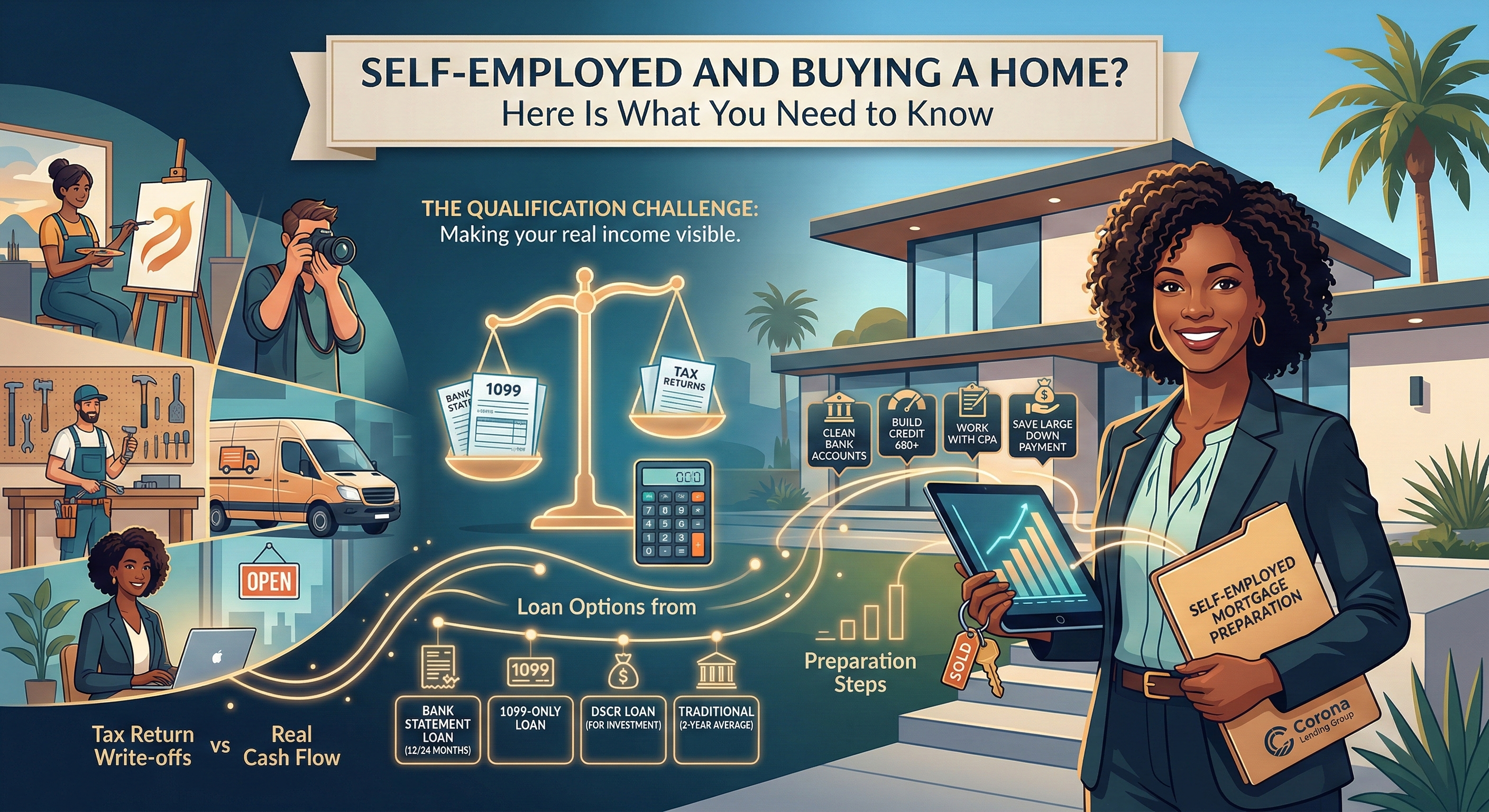
When a self-employed borrower applies, the lender also looks at two years of tax returns — but the problem is that most business owners are incentivized to show as little taxable income as possible by writing off legitimate business expenses. That lower taxable income is great for minimizing your tax bill, but it can look like you earn far less than you actually do in terms of real cash flow.
A self-employed borrower with $250,000 in actual revenue might show only $80,000 in taxable income after deductions. A conventional lender will base your qualifying amount on the $80,000 — which may not get you the loan size you need for the home you want.
Option 1: The Traditional Route (2-Year Tax Return Average)
If your taxable income after deductions is still strong enough to qualify, the conventional approach remains a solid option. You will need:
- Two years of personal tax returns (1040s)
- Two years of business tax returns (if applicable — S-Corp, LLC, Partnership)
- Year-to-date Profit and Loss statement
- Two months of business bank statements
- Business license or CPA letter confirming self-employment for 2+ years
Lenders calculate your qualifying income by averaging your net income over the past two years — with adjustments for depreciation and other non-cash deductions that can be added back. If the numbers work, this route gets you the best rates.
Option 2: Bank Statement Loans
Bank statement loans are specifically designed for self-employed borrowers and are one of the most popular alternatives to traditional income documentation.
Instead of tax returns, the lender looks at your business or personal bank statements — typically 12 or 24 months — and calculates your average monthly deposits as a proxy for income. This lets your real cash flow do the talking, rather than your tax-return income.
Here is how it generally works:
- 12-Month Program: Lender averages your monthly deposits over the last 12 bank statements.
- 24-Month Program: Lender averages over 24 months for a more conservative, stable look at income.
- Expense factor: Lenders typically apply an expense ratio (40-50%) to your deposits to estimate net income — this accounts for business expenses without requiring full documentation.
Bank statement loans typically come with slightly higher interest rates than conventional loans (usually 0.5% to 1.5% more), and require 10-20% down depending on the program. For many self-employed borrowers, the trade-off is absolutely worth it.
Option 3: 1099-Only Loans
If you are an independent contractor or freelancer and receive 1099s rather than W-2s, some lenders offer loans that use just your 1099 income — without requiring full tax returns. This avoids the penalty of excessive write-offs entirely and qualifies you based on your gross 1099 income.
Requirements vary by lender, but generally you will need 1-2 years of 1099 forms plus a letter confirming you are actively self-employed.
Option 4: DSCR Loans for Investor-Entrepreneurs
If you are a self-employed borrower purchasing an investment property — not your primary residence — a DSCR loan (Debt Service Coverage Ratio) may bypass your income documentation entirely. As I covered in another post, DSCR loans qualify the loan based on the rental income of the property, not your personal income.
This is a powerful option for business owners who want to invest in real estate without their write-offs getting in the way.
How to Prepare for a Self-Employed Mortgage Application
The earlier you start preparing, the smoother the process will be. Here is what I recommend:
- Work with your CPA to understand your qualifying income before you apply. If your tax-return income is too low, your accountant may be able to make legal adjustments on upcoming returns — but this takes time.
- Keep your bank accounts clean. Avoid irregular large deposits that are difficult to explain, and keep business and personal accounts separate.
- Build your credit. All loan programs benefit from a stronger credit score — aim for 680+ for the best terms.
- Save for a larger down payment. More skin in the game gives lenders more confidence in self-employed borrowers.
- Gather documentation early. Two years of returns, bank statements, and a current P&L statement will all be needed. Having them organized saves significant time.
Final Thoughts
Being self-employed does not mean being locked out of homeownership. It means you need a mortgage advisor who understands the options available to you and can find the right fit for your specific financial picture.
I work with self-employed borrowers regularly and have access to lenders with both bank statement and 1099 programs. If you want to find out exactly what you qualify for, let us talk.
Self-employed and ready to buy a home? Book a free consultation with Rudy Corona. I will find the loan that works for your real income — not just what the IRS sees.
Self-Employed Financing Made Simpler
We will review your income structure and identify the loan route that gives you the strongest path to approval.